
Mastering SEO: Boost Your Website’s Visibility and Organic Traffic

Have you ever wondered why there are always certain websites that are on the first page of Google and others are lost in the search results?
In the digital era, it is not enough to have a site, but your consumers must discover your site.
And that is where SEO (Search Engine Optimization) will help. With the knowledge of how to utilize SEO, companies will be in a position to increase their ranking in search engines, receive more organic traffic, and be more popular.
This guide will split the most critical strategies, such as keyword research of keywords and optimization on the page, and technical SEO and building links, to assist you in creating a comprehensive plan to gain more visibility in search and achieve measurable results.
Table of Contents
What is SEO and Why It Matters
Search Engine Optimization or SEO is the art of optimizing web pages and web content to enhance their ranking on the search engine results list, e.g., Google.
It also assists websites to gain organic traffic, enhance search visibility, and ensure that search engines can easily comprehend your content.
SEO is a combination of technical SEO, on-page SEO, and off-page SEO to improve user experience and the performance of the websites.
It is important for the following reasons:
Increases Organic Traffic
SEO will ensure that your site is listed in search engine results for the appropriate search queries, which will bring visitors to your site who are in the process of searching and buying your products or services.
This organic traffic is also cheap as compared to paid ads,s and in most cases, more active,e leading to increased click-through rates.
Through web content optimization and the use of the right keywords, a business can gradually increase its audience and web traffic as time goes by.
Enhances User Experience
An optimized site will be loaded quickly, be mobile, and easy to navigate.
Good SEO enhances user experience and makes search engines comprehend what is in your content, and also keeps visitors interested.
Such characteristics as good internal navigation, clear site architecture, and descriptive meta tags enhance the ease of search by users, which enhances the visibility of the searches and decreases the bounce rates.
Builds Brand Awareness
Always appearing in the first search results enhances brand recognition and trust among prospective customers.
The presence in organic searches of various search queries is a sign of authority and reliability, which will motivate users to identify with your brand.
The increased visibility also helps in marketing your business through social media and other marketing techniques, which increases your online presence on different platforms.
Improves Search Engine Rankings
SEO implements the following methods: keyword research, on-page SEO, off-page SEO, technical SEO, and site audits to ensure your web pages are crawled, indexed, and ranked higher in search engines like Google.
With the help of title tags, meta descriptions, URL structure, and schema markup, you can ensure that search engine crawlers can navigate your site easily, leading to increased rankings and organic traffic.
Supports Long-Term Marketing Goals
In contrast to short-term advertising, SEO creates long-term outcomes through a continuous enhancement of search visibility and organic traffic.
It fits perfectly with the digital marketing initiatives such as search engine marketing, social media, and content marketing, which offer quantifiable ROI.
SEO builds your website authority, domain authority, and the general presence on the internet over time, and this makes it one of the pillars of sustainable marketing strategies.
Types of SEO
SEO can be classified into these primary categories, which play various roles in the ranking of search engines and organic traffic:
On-Page SEO
On-page SEO is concerned with the optimization of individual web pages so as to render them relevant and understandable to the users and the search engines.
It entails keyword research, meta description, title tags, alt text, and internal linking.
On-page SEO improves user experience, increases search engine perception of your content, and increases clickthrough rates.
Off-Page SEO
Off-page SEO involves off-site strategies such as linking, social media marketing, and brand mentions.
These activities boost the domain authority and search visibility, which sends signals to search engines like Google that your site is trustworthy.
Good off-page SEO can contribute to the rise of the search engine position and attract more organic traffic.
Technical SEO
Technical SEO is a method of optimization of the back end of your site to make sure that search engine crawlers can crawl, index, and rank your pages.
These are site structure, URL optimization, schema markup, and site speed.
A well-crafted site will increase search engine ranking, improve user experience, and your web content will perform well in the organic search.
Local SEO
Local SEO assists companies in appearing in search engines such as Google when the search is location-based to bring customers to the company.
It is necessary to raise the local search presence and to attract the organic traffic to the physical stores or service zones.
Keyword Research: Finding Relevant Keywords
Keywords research refers to the act of finding out the keywords your target market uses.
With the correct keywords, it is possible to optimize web content to suit the search intent, enhance organic traffic, and boost search engine ranking.
Understanding Search Intent
Before selecting keywords, one has to know the intent of searches, whether a user intends to make a purchase, learn,n or compare.
Relevance to search intent enhances the rates of clickthrough, user experience, and search visibility.
Using SEO Tools for Keyword Research
The tools that will be used include Google Search Console, Google Analytics, and other search engine optimization tools like Semrush, Ubersuggest, and Ahrefs, which will help to find the relevant keywords and define their search volume, competition, and CPC.
These are the insights that inform the choice of terms to be used in organic searches.
Long-Tail vs Short-Tail Keywords
Short-tail keywords are competitive and broad, whereas long-tail keywords are specific and easy to rank.
With a mix, you will guarantee that your content has a high search visibility as well as highly targeted organic traffic.
Competitor Keyword Analysis
A competitor analysis of their websites reveals the search engine keywords on which they are ranking.
This will help you to determine the gaps, where to find quality content opportunities, and how to optimize your search engine strategy.
Prioritizing Keywords for Content
Research: once research is done, prioritize keywords based on search volume, relevance, and competition.
Focus on the keywords that will help you achieve your marketing goals and help your site to achieve long-term organic traffic.
Optimizing Web Pages for Search Engines
Web page optimization will make the search engines know what is on your pages and rank higher when relevant search engines are used.
It entails enhancing on-page SEO factors such as meta tags, title tags, alt text, URL structure, and developing high-quality content that will draw organic traffic.
Meta Tags
Meta descriptions and meta tags summarize your page content to the search engines and users.
Meta tags that are well written enhance the number of clicks that are generated by search engine results, and thus, your pages are more attractive in SERP features.
Title Tags
Title tags are used to determine the primary subject of a page and can be found in search engines and tabs.
Maximizing titles using keywords that are relevant helps search engines to know what you are talking about and increases search visibility.
Alt Text for Images
Alt text on images enhances accessibility and informs search engines of the content of the image.
Optimization of images can be considered as part of on-page SEO and makes your pages look in image search, as well as improves the overall user experience.
URL Structure
Both users and search engines can understand your pages easily because of clean and descriptive URL structures.
The use of relevant keywords in the URLs enhances crawl indexing, better ranking of the site in the search engines, and strengthens the site structure.
High-Quality Content
The production of good-quality, informative content that satisfies the queries of the users enhances search engines and organic traffic.
The use of relevant keywords, structured headings, and internal links makes the content valuable, easy to navigate, and comprehensible by search engines.
Internal Linking and Site Structure
Proper internal linking and a clear site structure help search engines to know what is on your pages and enhance crawl indexing.
The connection of related web pages helps in taking the visitors through your web page, sharing link authority, and improving user experience.
Having good navigation enables one to locate the content with ease, spend more time on the site, and enhance organic traffic and search engine ranking.
Using Structured Data and Schema Markup
The structured data and schema markup enable search engines to comprehend the information on your site more accurately.
These features can be improved by including this code in your web pages and increasing SERP features, such as rich snippets and knowledge panels, which make your search more visible.
Schema will improve the number of clicks, organic traffic, and make your content visible in search engines.
Monitoring SEO Performance with Tools
Monitoring the performance of SEO is necessary in order to know the performance of your website traffic, ranking, and user engagement.
The correct SEO tools will also assist in determining where you need to improve and maximize your search presence.
Google Search Console
Google Search Console will reveal how your site will be ranked in search results, which keywords will be used to attract traffic, and whether there are any crawling errors.
It assists you in tracking the search engine indexing and detecting problems that are impacting organic searches.
Google Analytics
Google Analytics tracks the behaviour of visitors, the frequency of clicks, and the origin of traffic.
It provides you with a clue of the web pages that are performing the best, and this will help you to optimize the content and structure of the site to improve the user experience.
Keyword Tracking Tools
The SEO tools that you can use to track the ranking of the keywords, search volume, and competition are Ahrefs, SEMrush, Ubersuggest, and Moz.
These will be used to make the content updates and on-page optimization to improve search engine ranking.
Backlink Analysis Tools
Tools of backlink analysis help in monitoring the quality of links, domain authority, and off-page SEO performance.
Backlinks will enhance the organic traffic and brand credibility, as well as the visibility of the search engine.
Technical SEO Audit Tools
The site speed, URL structure, crawl errors, and schema markup errors are identified with the help of technical SEO tools.
Periodic audits ensure that the search engines like Google have the ability to crawl, index, and rank your pages successfully.
Avoiding SEO Issues: Duplicate Content and Spam Policies
In order to retain the ranking of the search engines and organic traffic, it is important to ensure that the site is kept clean.
By avoiding these dangers of SEO as content duplication and spamming, you will ensure that your site will not lose its reputation and will be listed in search engines.
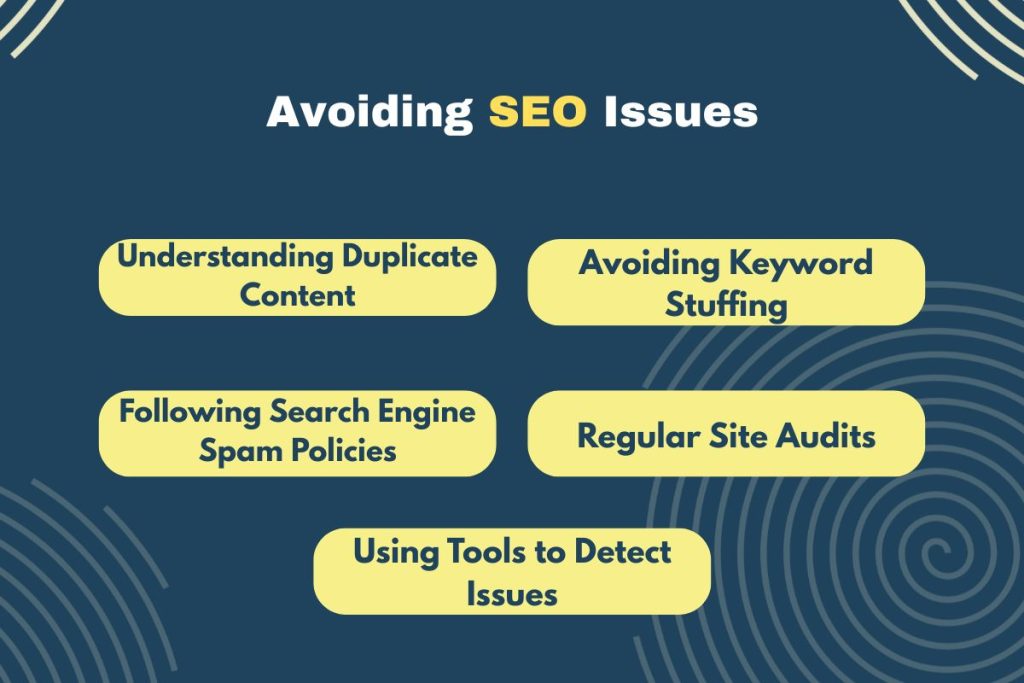
Understanding Duplicate Content
Duplicate content is a scenario in which the same web pages or text appear in numerous places in your site or on the web.
Search engines can penalize it and reduce search visibility and organic traffic.
Problems will be avoided with the help of canonical tags and original content.
Avoiding Keyword Stuffing
Web pages can use keywords in excess, which results in search engine penalties.
Note that it is preferable to incorporate the keywords that are relevant in the meta description, title tags, and content in a natural manner, and user experience is a priority.
Following Search Engine Spam Policies
By adhering to Google's spam policies, one is spared the punishment that has adverse effects on search engine ranking.
Do not use backlinks that are of poor quality, redirects, or hidden text to preserve domain authority and search visibility.
Regular Site Audits
SEO audit determines the presence of duplicate content, broken links, and technical problems.
The frequent audits are used to keep the site clean, maximize crawl indexing, and enhance search engines.
Using Tools to Detect Issues
Duplicate content, spam problems, and crawl errors can be detected with the help of such tools as Google Search Console or Screaming Frog.
These insights enable you to fix the SEO issues in a short period and maintain the growth of organic traffic.
Developing an Effective SEO Strategy
A good SEO strategy integrates on-page SEO, off-page SEO, technical SEO, keyword research, and content optimization into a unified strategy.
This will enhance search engine ranking, boost organic traffic, and improve user experience.
Setting Clear Goals
Determine your desired outcome of SEO, whether it is more traffic to your site, more search visibility, or brand recognition.
Specific objectives can be used to prioritize the work and assess the ROI of the SEO work.
Conducting Keyword Research
Find the appropriate keywords that align with search intent and focus on organic searches.
Analyze search volume, competition, and user behavior using SEO tools and make sure that the content is in line with the needs of the audience.
Optimizing Web Pages
Enhance meta tags, title tags, alt text, URL structure, and quality content per page.
On-page SEO is proper, and it assists the search engine in comprehending your pages and increases the click-through rates.
Building Authority and Links
Adopt off-page SEO by building links, social signals, and mentioning the brand.
Good backlinks enhance the domain authority, boost search engine ranking, and generate more organic traffic.
Monitoring and Adjusting
Monitor performance, identify problems, and optimize strategies using Google Search Console, Google Analytics, and other search engine optimization tools.
Constant monitoring will keep your SEO strategy updated to changes in the algorithms and will keep you successful in the long term.
Frequently Asked Questions
What does SEO stand for?
SEO stands for Search Engine Optimization, the process of improving a website’s visibility in search engine results to increase organic traffic.
How long does SEO take to show results?
SEO is a long-term strategy, and results usually appear within a few months, depending on competition, content quality, and optimization efforts.
What is the difference between on-page and off-page SEO?
On-page SEO focuses on optimizing web pages and content, while off-page SEO involves link building and external signals that build authority.
Why is keyword research important for SEO?
Keyword research helps identify what users are searching for, allowing you to create content that matches search intent and attracts organic traffic.
Do small businesses need SEO?
Yes, SEO helps small businesses improve search visibility, attract local customers, and compete effectively without relying solely on paid ads.